MOBOX is an innovative Gaming Platform that combines the best of DeFi Yield Farming and GameFi NFTs (MOMOs) to create a truly free to play and play to earn ecosystem.
The CMP is $6.6 as of 26th November 2021.
What is MOBOX?
MOBOX’s goal is to use NFT’s to connect each metaverse, ushering in a new era of NFT interoperability across blockchain games and platforms. MOBOX also seeks to increase the usefulness of NFTs associated with blockchain gaming titles and bring new utility through a variety of initiatives.
Why MOBOX matters and its problem solving capabilities
For both novice and seasoned cryptocurrency fans, the mix of DeFi, blockchain gaming, and NFTs provides unique prospects. MBOX tokens may be earned reasonably easily through a variety of games. Furthermore, seeing a free-to-play model mixed with earn-to-play is exciting. The latter notion has proven to be successful in a variety of games, although it frequently necessitates an initial commitment. MOBOX takes a new approach, aiming to create a user-friendly environment.
Furthermore, the ecosystem provides tools for game and NFT development, allowing developers to experiment with new ideas. Aspiring game creators may find that launching and distributing games on this platform is a feasible method to get their name out there.
Fundamentals of MOBOX
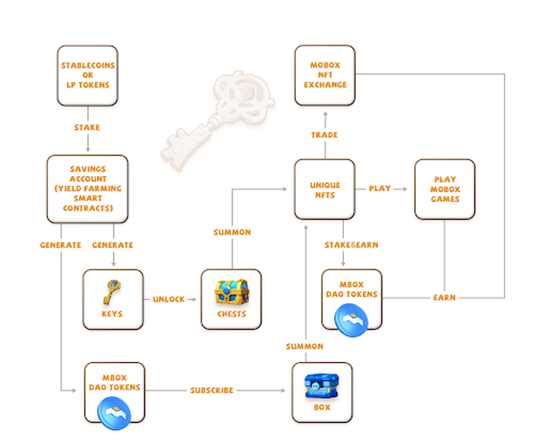
The community-driven platform aspires to provide users more control over their involvement and experiences. Its infrastructure is inspired by play-to-earn games, yield farming in decentralised finance, and the popularity of non-fungible tokens. All of these concepts are accessible through an ecosystem designed to allow people to play for free and receive incentives for being as engaged as possible.
MOMOs are MOBOX’s native NFTs, which may be obtained through mystery boxes. Users who get these NFTs can sell them, stake them for MBOX token farming, or use them as collateral in other games in the ecosystem.
MOBOX is known as “GameFi,” a combination of the words “gaming” and “decentralised finance (DeFi).” The word “DeFi” refers to a variety of services that eliminate the intermediary in financial transactions.
Use cases:-
In-game currency:-Players can use MOBOX tokens to make in-game purchases, such as buying new characters. It’s also used as a reward for the in-game activity.
Staking: Staking for platform bonuses and incentives.
Governance: MBOX holders can submit and vote on proposals that help determine the future of the platform.
Buyback & Burn:The platform has also implemented a buyback and burn program funded by 80% of all profits across the platform, which will reduce the maximum token supply of MBOX over time.
Transaction Fee:Processing of transactions through the NFT gaming platform.
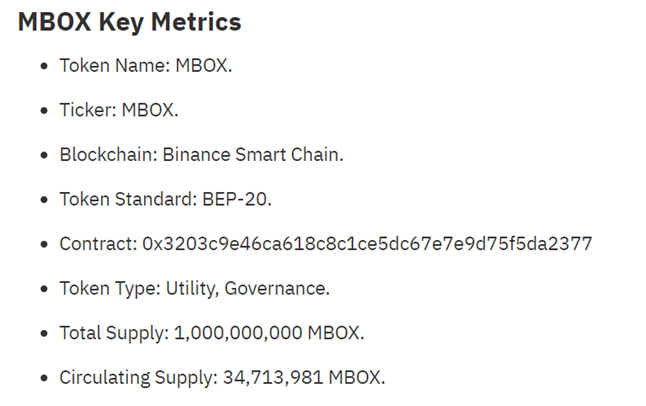
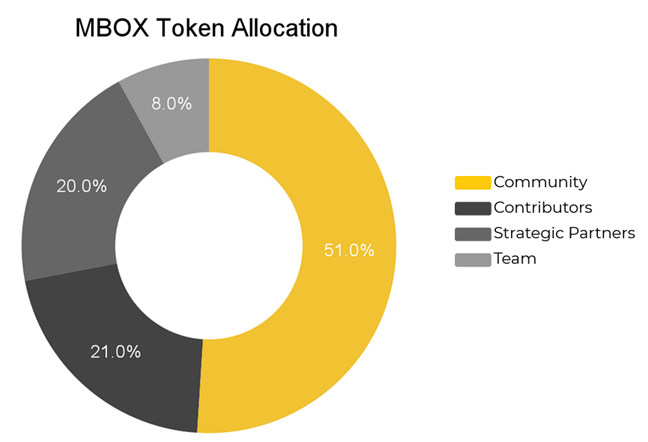
Tokenomics
Conclusion
The protocol has a lot of cool characteristics that make it stand out. The MBOX token is a native utility token for it. It runs the network and fulfils a variety of functions in the ecosystem, including governance votes to allocate resources.
The MBOX token is also used for staking for incentives and bonuses, as well as processing transactions via the NFT gaming platform. MOBOX contains native NTFS called MOMOs, which can be obtained from mystery boxes. These MOMOs can be traded, staked to farm MBOX tokens, or used as collateral on the platform.
Pros
Processing of transactions through the NFT gaming platform.
Staking for platform bonuses and incentives.
Voting in management to determine how resources are allocated.
Cons
It has a poor user experience
Decentralized apps have gone a long way, but the issue of scalability must be addressed before they can take the next big step.
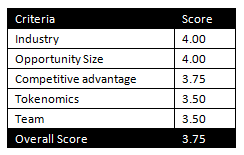
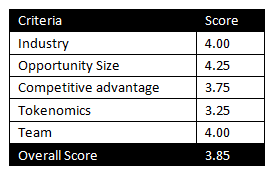
MintingM rating for MOBOX: 3.75/5
Get deeper insights into the crypto market’s weekly trends discussed on ourSpotify podcast.
Start your Crypto Investments with XMINT Bots today
Chromia is a new blockchain platform for decentralised applications that was created in response to existing platforms’ limitations and is aimed to help a new generation of dapps scale.
The CMP is $1.15 as of 19th November 2021.
What is Chromia?
Chromia is a blockchain platform that tries to tackle the issue of dApp scalability. A network of relational blockchains makes up the platform. Developers from all around the world may write dApps in a fashion that is familiar to them, whether they work on major business apps, games, or smaller projects. Each blockchain in Chromia is paired with a set of validator nodes, which is a subset of all nodes in Chromia, similar to sharding in Ethereum.
Why Chromia matters and its problem solving capabilities
Chromia sets itself apart from other blockchain systems by employing relational databases, which have decades of real-world industry experience in a variety of sectors. The Rell programming language on the platform boasts of being simpler to learn and more efficient than other blockchain languages. It allows developers to code seven to ten times quicker by allowing them to use less lines of code.
The Chromia Vault is a wallet that allows users to manage their tokens and dApps on the Chromia blockchain, while the Chromia Vault Single Sign On is a unique feature that eliminates the need for users to enter passwords while maintaining security.
Fundamentals of Chromia
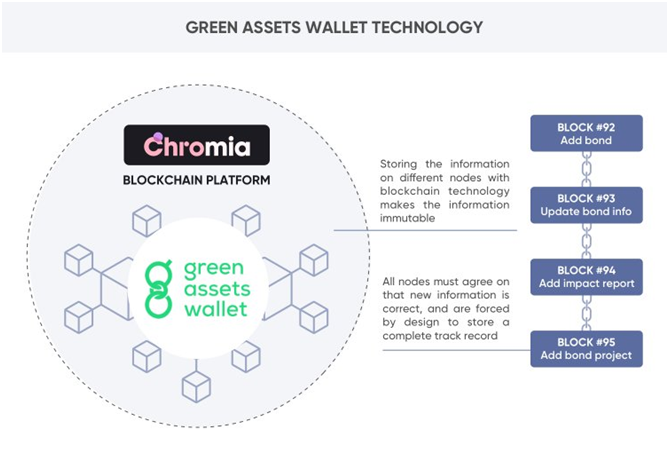
Chromia embeds a blockchain into a database and provides a lightweight software layer for voting and consensus. This results in the formation of nodes, which are dispersed across a number of different individuals. When someone requests data to be written, it is sent to one of the nodes that shares it with the others. The nodes examine the request and, if they agree, the data is written to the blockchain and logged.
A relational database stores the blockchain data and application state, enabling flexibility, variety, and consistency. Chromia is therefore well suited for usage as a business blockchain as well as an independent public blockchain. Chromia may also be utilised as a Layer 2 to Ethereum, reducing the cost of development and transactions.
Rell, a fast and ubiquitous programming language invented by Chromia and based on SQL, allows developers to construct a wide range of applications.
Use cases:-
Global banking or financing services:- Compliance is a challenge for banks and financial services, payment settlements are typically sluggish, and cybersecurity threats are becoming more common. Blockchain allows banks to trade directly with one another, eliminating friction and the risk of double-spending and fraud. The distributed and unchangeable ledger architecture of blockchain also facilitates regulatory reporting for businesses and regulators.
Contract Law:- Blockchain technology has the ability to close existing contract law flaws. Smart Contracts powered by the blockchain provide a variety of services that allow the parties involved to keep permanent records of all transactions.
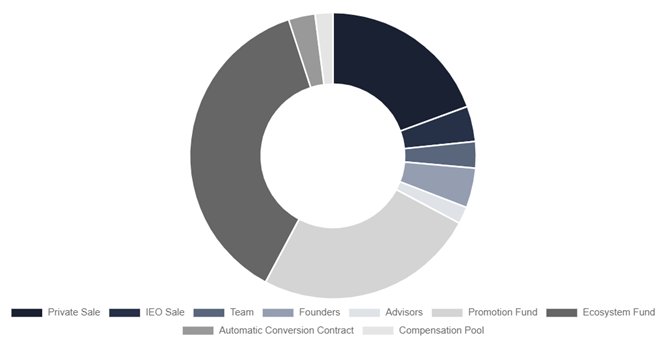
Tokenomics
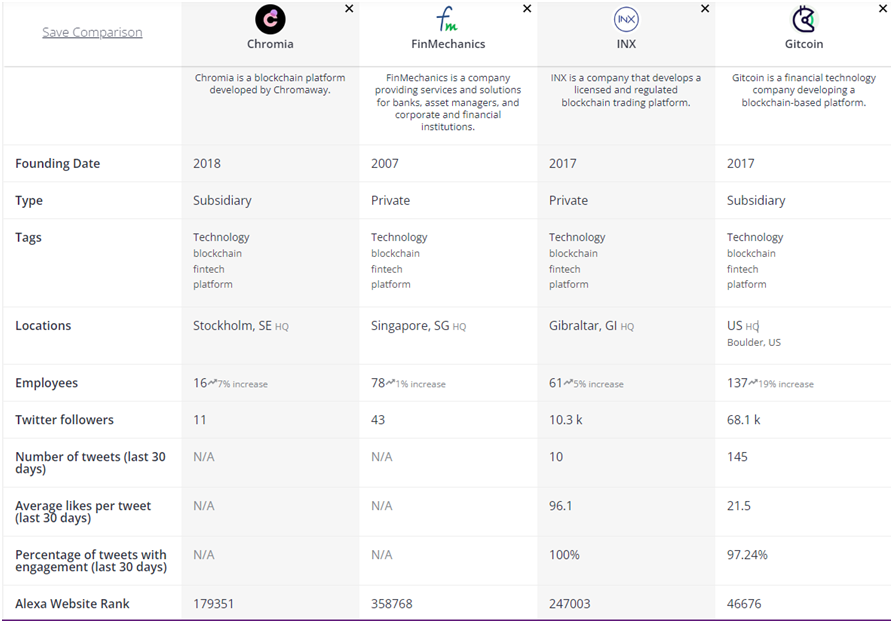
Competition Analysis
Team, Media & Community strength
CEO Henrik Hjelte, COO Or Perelman, and CTO Alex Mizrahi co-founded Chromia. Colored Coins, a blockchain token platform, and Safebit, a Bitcoin wallet, were both established by members of the team earlier. 21M Capital, Arrington XRP Capital, and Neo Global Capital were among the project’s sponsors, all of whom are well-known in the blockchain field.
There are 50 members currently on the Chromia team, which included 20 people on the technical team, 8 people on the marketing team, and 9 people on the consultant team. The team is well structured and the distribution of the employees seems reasonable. It’s noteworthy that 3 co-founders of ChromaWay are the CEO, COO, CTO respectively. Their cooperation will ensure the progress of this project and improve the organizational efficiencies.
Conclusion
The relevance of relational blockchain is growing as the blockchain technology advances. For the whole sector to prosper, industry participants must make a concerted effort to collaborate in order to achieve the shared aim of bringing blockchain technology to the public. Instead of attempting to wrestle from one other, the industry can only thrive by spreading outwards.
Pros
Chromia platform is considered as layer two to Ethereum platform
Especially for decentralized applications, CHR is ideal for resource use fees
Cons
Chromia has to still come up with a way to deal with the evils of counterfeiting money in the digital space
Chromia is not a unique product and with as ETH 2.0 is expected to launch in the future, we cannot assert what the future holds for CHR
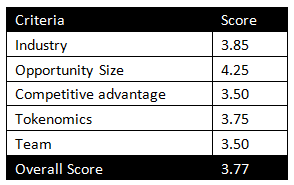
MintingM rating for Chromia: 3.77/5
Get deeper insights into the crypto market’s weekly trends discussed on ourSpotify podcast.
Start your Crypto Investments with XMINT Bots today
Raydium is an AMM protocol built on the Solana Block Chain that offer on-chain liquidity to a central limit order book.
The CMP is $11.29 as of 12th November 2021.
What is Raydium?
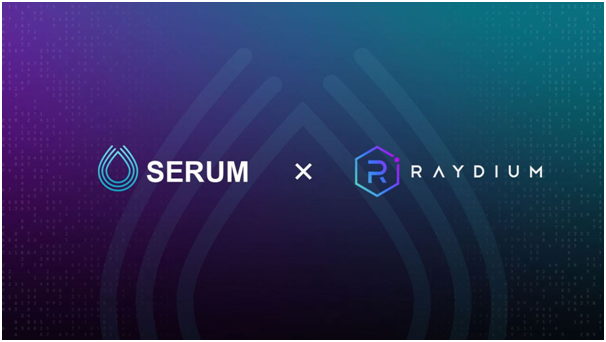
Raydium is a Solana-based automated market maker (AMM) that uses the Serum decentralised exchange’s central order book to offer lightning-fast transactions, pooled liquidity, and additional features for generating income.
Why Raydium matters and its problem solving capabilities
Liquidity is only available within the pools of other AMM Dexes and DeFi protocols. As a result, they are unable to access a central order book. In addition, the majority of the exchanges use the Ethereum blockchain, which causes network congestion. As a result, transaction times are poor, and the network charges hefty gas prices.
Raydium provides many benefits to its consumers as a result of its integration with Serum on the Solana blockchain. Token trading, staking, exchanging, and farming are just a few of them.
Raydium transactions are cheaper and quicker transactions than Ethereum because of their reliance on Serum on the Solana blockchain. Furthermore, the gas prices are lower than those on the Ethereum network.
Wide liquidity for the ecosystem via a central limit order book — Raydium provides Serum’s central limit order book with boundless liquidity. As a result of Raydium’s capability, the whole Solana ecosystem has access to continuous liquidity and order flow.
Wonderful trading interface – Users may see their trading charts using this amazing interface. They will be able to better control their trades and establish limit orders as a result of this.
Fundamentals of Raydium
The protocol includes a trading platform that is tailored to the needs of professional cryptocurrency traders. The platform’s features and tools provide excellent trading opportunities for users. Buying, selling, trading, and other transactions are carried out at rapid speeds.
There are costs known as takers and makers fees when it comes to controlled exchanges. Customers who remove liquidity from orders are known as takers. The clients who submit the orders are the manufacturers. On their platforms, the CEX often adopts a flat charge scheme for both takers and manufacturers. As a result, both the taker and the creator of an order will be charged at the same time.
Decentralized exchanges, on the other hand, seldom contain modifications in their operations. This is still a significant edge they have over their CEX competitors.
Raydium, on the other hand, adheres to its exchange costs. The protocol charges both takers and makers a 0.25 percent liquidity fee on all transactions.
Use cases:-
Staking: RAY token holders will be able to stake their tokens in order to increase their yield.
RAY holders are permitted to engage in and vote on community ideas and revisions with limited governance.
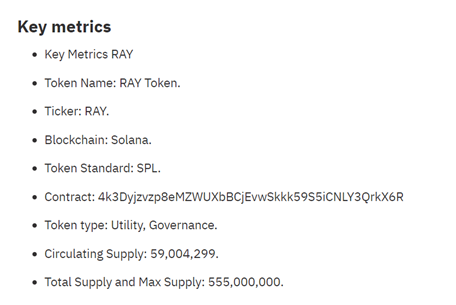
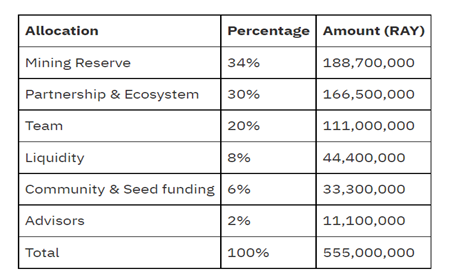
Tokenomics
Competition Analysis
Serum is a central limit order book with a matching engine
Raydium is a AMM (automated market maker)
So back before Solana you could not run a CLOB because every limit order was itself a transaction (that may or may not get filled) so…this wouldn’t work on Ethereum because of gas fees.
Serum is the first of its kind.
In Raydium’s case you can trade on the raydium dex page (that uses the serum order book) or make a swap through In house liquidity pools
When you make a swap, Raydium decides if it can swap you in house through the AMM or through serum. If the slippage is smaller on serum it will swap through serum if not it will swap through Raydium. (Raydium is unique in this case because I believe it was also the first to have a synergistic relationship with a CLOB) thus the user experience was great.
Team, Media & Community strength
Raydium’s entire strategy, operations, product direction, and company development are all overseen by AlphaRay. Alpha shifted from algorithmic commodity trading to market creation and liquidity provision for cryptocurrencies in 2017 and hasn’t looked back since.
Raydium’s Chief Technology Officer and Dev Team Leader is XRay. X has 8 years of expertise in both regular and crypto markets as a trading and low latency systems design.
GammaRay is in charge of marketing and communications, as well as strategy and product development. Gamma worked on both client engagements and corporate marketing for a major portion of his career at a renowned data analytics and market research agency.
StingRay is an experienced operating system and trading developer with an eye for detail and new solutions. StingRay turned his attention to trading after working on the systems kernel for an autonomous car driving firm. He is now the senior developer for Raydium’s on-chain order book AMM.
Conclusion
Raydium is one of the most popular AMMs in the DeFi area, allowing users to trade using the majority of CeFi’s capabilities. As a consequence, by acting as a bridge between CeFi users and the crypto world, this will promote the growth of the DeFi domain.
Pros
Faster and cheaper :- Raydium takes advantage of the Solana blockchain to execute more transactions than Ethereum’s blockchain with extremely low gas fees.
Central order book provides liquidity across the ecosystem:- Raydium allows access to the order book as well as the liquidity of the entire Serum ecosystem.
Trading interface:- Allows convenient market analysis via TradingView, placing limit orders and having more control over your trading on Raydium.
Cons
The operation of transferring assets to the exchange is quite complicated.
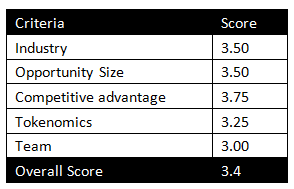
MintingM rating for Raydium: 3.4/5
Get deeper insights into the crypto market’s weekly trends discussed on ourSpotify podcast.
Start your Crypto Investments with XMINT Bots today
Illuvium is an open world narrative driven exploration game. It combines elements of traditional RPGs collection games with fight mechanics seen in the popular Auto Battler genre.
The CMP is $1269 as of 5th November 2021.
What is Illuvium ?
Illuvium is an Ethereum-based, decentralised NFT collecting and auto battler game. Illuvium participants benefit from zero gas fees for minting or trading assets, as well as sub-second transaction speeds and user-controlled custody, thanks to its integration with the hyper-scalable Immutable-X L2 solution.
Why Illuvium matters and its problem solving capabilities
Illuvium, unlike most other blockchain-powered games, has a fully 3D landscape with over 100 distinct Illuvials strewn over its many areas. Each Illuvial is created by a team of world-class artists to appeal to gamers who are accustomed to high-end retail games.
Beyond this, it boasts a number of features that help it stand out from both other blockchain- enabled games and AAA titles. These include :-
Layer 2 integration:- Despite the fact that Illuvium is protected by Ethereum, it is built on Immutable X (IMX), a layer-2 solution for scaling applications with NFT capability. Illuvium assures that participants may mint and trade their NFTs with zero gas fees and near-instant transaction finality by exploiting Immutable X’s capabilities. While using IMX, players are always in control of their assets.
The IlluviDEX:- Illuvium has an integrated decentralised exchange (DEX) platform called the IlluviDEX. This may be used to exchange Illuvium assets, such as Illuvial NFTs, in a secure manner. Each sale is subject to a 5% charge, which is channelled into the ILV staker rewards pool.
Yield Farming:- The Illuvium yield farming programme will get 3 million ILV, which is comparable to 30% of the maximum supply (10 million). These will be awarded over a three-year period to users who provide liquidity as well as through other partner incentive schemes.
Fundamentals of Illuvium
Illuvium is more comparable to a full-fledged video game than a blockchain-based project. It’s accessible via a downloaded desktop client, but it’s surrounded by a number of DeFi apps, including a produce farm and a decentralised exchange.
Players battle Illuvials and other players in the Illuvium terrain, taking part in missions and daily challenges, and following the game’s common plot. They gather Illuvials along the way, which have a variety of properties that make them varied in rarity, utility, and attractiveness. These include
Classes: Empath, Fighter, Guardian, Rogue and Psion.
Affinities: Air, Earth, Fire, Nature and Water.
While its class and affinity are the most essential features, each Illuvial has a slew of other characteristics that contribute to its fighting strength, including attack damage, attack speed, and ferocity. Illuvials gain strength as they go through the game, may be boosted with in-game supplies, and can be upgraded into an unique “ascended” form that benefits from two affinities at the same time.
Each Illuvial has its own non-fungible token (NFT), which may be freely sold on external exchange platforms as well as the gas-free IlluviDEX (more on this later). They may also be merged together to create more powerful forms, and are available in standard, holographic, and dark holographic types, the latter of which is far more uncommon.
The game will generate income from a multitude of sources, the majority of which will come through in-game sales of goods, crafting materials, cosmetics, and shard curing. Through an ILV repurchase scheme, 100% of this revenue is given as incentives to individuals staking the ILV tokens.
Use case:-
Using what is known as a Zero-Knowledge (ZK) Rollup, users may trade their NFTs without incurring gas expenses. Aside from the cost savings, there are a number of other advantages to this.
You keep control of your NFTs with the same degree of security as mainchain Ethereum, which is something that alternative scaling options like Matic and xDai don’t offer.
Transactions are instantaneous, and reverting to Ethereum’s mainchain is secure and verifiable.
To purchase, sell, transmit, or receive NFTs, you do not need to hold a unique L2 token, unlike previous alternatives.
Tokenomics
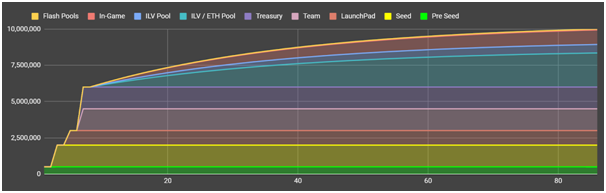
The maximum number of ILV tokens in the market at full dilution will be 10,000,000. Prior to the game’s release, 9,000,000 will be in circulation, with the last million divvied out as in-game rewards and for tournament victories. A further 1,500,000 tokens are already held by the DAO in the treasury for further distribution to in-game achievements and tournaments.
The 2,000,000 ILV tokens distributed during seeding are scheduled to unlock in March 2022, and will be drip-fed out at a rate of 1/12 per month for 12 months. The 1,500,000 ILV tokens held by the team will also be drip-fed out from that time, but at a rate of 1/36 per month for 3 years.
Competition Analysis
Illuvium and Axie Infinity:-
Despite the fact that both Illuvium and Axie Infinity have collectible in-game characters that can be battled, exchanged, and enhanced, the scale of the game environment surrounding these critters differs.
On the one hand, Illuvium is a 3D role-playing game with a slowly disclosed storyline and a large, open, explorable terrain, whereas Axie Infinity is a popular, quirky 2D game with charming monsters called Axies that look like Pokemon. Axies can be bred, traded, and battled. There is currently no narrative mode available.
Both Illuvium and Axie Infinity include a strong gamified DeFi element, which means real Ether (ETH) can be at stake while playing either — since some Illuvials and Axies can be sold for a lot of money on the open market.
Unlike Axie Infinity, which creates each Axie from a random collection of assets, Illuvium’s Illuvials are completely unique. Each one has unique artwork and rigging to ensure that they stand out and are representative of their properties and location.
Team, Media & Community strength
Kieran is the co-founder of illuvium has a track record of success as a serial entrepreneur. Kieran was first exposed to Bitcoin and Ethereum while working in e-commerce with his brother Kain Warwick. His interest in the crypto realm led him to Blueshyft. Kieran successfully onboarded major Australian exchanges and launched the world’s first OTC cryptocurrency exchange while he was there.
At Illuvium, Aaron is the Co-Founder, Chief Game Designer, and Story Supervisor. He’s a seasoned businessman with a background in sports and business—everyone in the Warwick family has a sporting background—and has run multimillion-dollar retail companies. Aaron owns and manages two large Australian sporting complexes in his spare time.
Their media presence seems to be growing significantly with over 132K Twitter followers and over 14K Telegram members.
Conclusion
Illuvium’s tokenomics are highly appealing, with a fixed maximum of 10 million ILV and only the possibility of a reduction with the issuing of sILV. In addition to regular token price appreciation, revenue distribution gives a long-term potential for value.
Pros:-
Gameplay mechanics that are both deep and engaging.
Unreal Engine 4 promises a fully immersive experience.
The entire profit goes back into the community.
Strong token distribution approach.
There’s room for growth and spin-offs.
Cons:-
Novice development team
No genuine gameplay footage to back up plans
Pitches based on concept art
Game delay likely
Only 100 Illuvials at launch
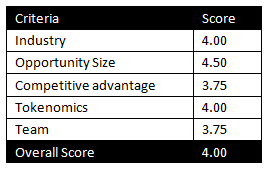
MintingM rating for Illuvium: 4.0/5
Get deeper insights into the crypto market’s weekly trends discussed on ourSpotify podcast.
Start your Crypto Investments with XMINT Bots today
Kava is a software protocol that allows users to borrow and lend assets without the necessity of a typical financial middleman by utilising several cryptocurrencies. In this report, we lay emphasis on how the project works, its problem solving capacity and review the pros and cons.
The CMP is $5.61 as of 29th October 2021.
What is Kava?
Kava is a cross-chain DeFi Hub for decentralized financial services and applications. The Kava DeFi Hub operates like a decentralized bank for digital assets connecting users with products like stablecoins, loans, and interest-bearing accounts so that they can do more and earn more with their digital assets. Users obtain weekly incentives in the form of KAVA, Kava’s cryptocurrency, by collateralizing coins to mint USDX.
Why Kava matters and its problem solving capabilities
KAVA, in particular, decentralises network administration by allowing anybody who owns and stakes the coin to vote on its software regulations and rules.
The KAVA coin is used to reward users who mint USDX and plays an important part in the Kava network’s administration.
Users who own and stake KAVA can vote to modify certain programme characteristics. These factors include, but are not limited to, the assets accepted as collateral by the protocol, the needed collateralization ratio, and the costs paid by borrowers.
Kava users may also delegate KAVA to the validators that administer the blockchain and compete for newly minted KAVA, awarding votes to them in exchange for a share of the stability fees paid by users shutting CDPs.
KAVA coins, like many other cryptocurrencies, have a finite supply, which means that according to the software’s regulations, there will only ever be 100 million KAVA.
Fundamentals of Kava
The functionality of smart contracts employed by the Kava lending protocol to support a peer-to-peer lending system is dependent on the protocol’s functioning. Users can lock their cash in smart contracts, which results in the creation of new USDX tokens that can be used as collateral for a loan. The next phase in this process is automated, and it involves creating a specific smart contract that binds the value of USDX to the value of the US dollar, therefore reducing volatility in the cryptocurrency market. A collateralized debt position is what it’s termed. Users can build CDPs by depositing bitcoin into smart contracts using linked digital wallets. The Kava system will immediately lock the monies in a smart contract whenever they are deposited. The
system then creates new USDX stable coins depending on the amounts deposited, allowing users to take out a USDX loan.
Users must clear their loan and pay a lending charge to cancel the CDP and receive the collateralized crypto. When the user cancels the CDP, the initial collateral is returned to the same wallet, and the borrowed USDX is burned, or destroyed, by the Kava system. The system also uses a collateralization ratio to shield the protocol against volatility and guarantee that USDX is over-collateralized to prevent the collateral from depreciating in value.
Use cases:-
Chainlink Price Oracle:-
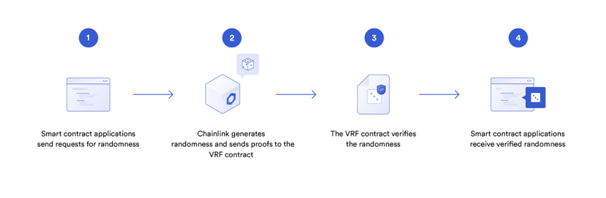
The oracle client will ask the Binance v3 API for pricing information about that asset at the crontab frequency selected. If Binance goes down, CoinGecko will take over. It will submit a postprice transaction to the blockchain along with a period when that price should be deemed expired if the price satisfies the posting criteria (default is 0.5 percent change from the previous posted price). At the conclusion of each block, the asset’s current price is determined by the median price of all oracles.
Sentinel:-
Sentinel is built to run several copies at the same time. This redundancy should make it able to have a tx validated swiftly and reliably amid volatile market conditions.
It’s crucial to make sure there aren’t any race conditions between the copies. Two bots, for example, might opt to remove debt and send in tx. If both txs are confirmed, the debt will be repaid twice as much.
Auction Bot:-
The auction client will poll the kava blockchain for active auctions at the crontab frequency set. It will bid on auctions that fulfil the conditions using the provided parameters. The client uses the Binance v3 exchange API to get the current spot price of the collateral asset in order to calculate margin. If Binance is unavailable, CoinGecko is utilised as a fallback.
Tokenomics
Competition Analysis
Team, Media & Community strength
Brian Kerr is the CEO of Kava and one of its co-founders. He founded Fnatic Gear, the first firm to make Esports gear and apparel developed by Esports players for Esports fans, after graduating from San Francisco State University with a Bachelor’s degree in Business Administration.
Conclusion
Kava is an intriguing DeFi project, but I’m not sure we need another MakerDAO-style initiative. On the other hand, having access to a collateralized debt position platform that can use any crypto asset is advantageous.
Pros
Support for cross-chain assets is generous.
USDX stablecoins are produced and donated to a Hard protocol, providing a yield-earning alternative.
Masternodes and staking options are available, as well as high payouts for the top 100 validators.
Cons
Has a Kava Safety Committee that has the ability to break the chain. This raises concerns about the decentralization of the system.
The top validators have a disproportionate amount of kava voting power (15-10-2021). For further information, see the coin distribution chart above.