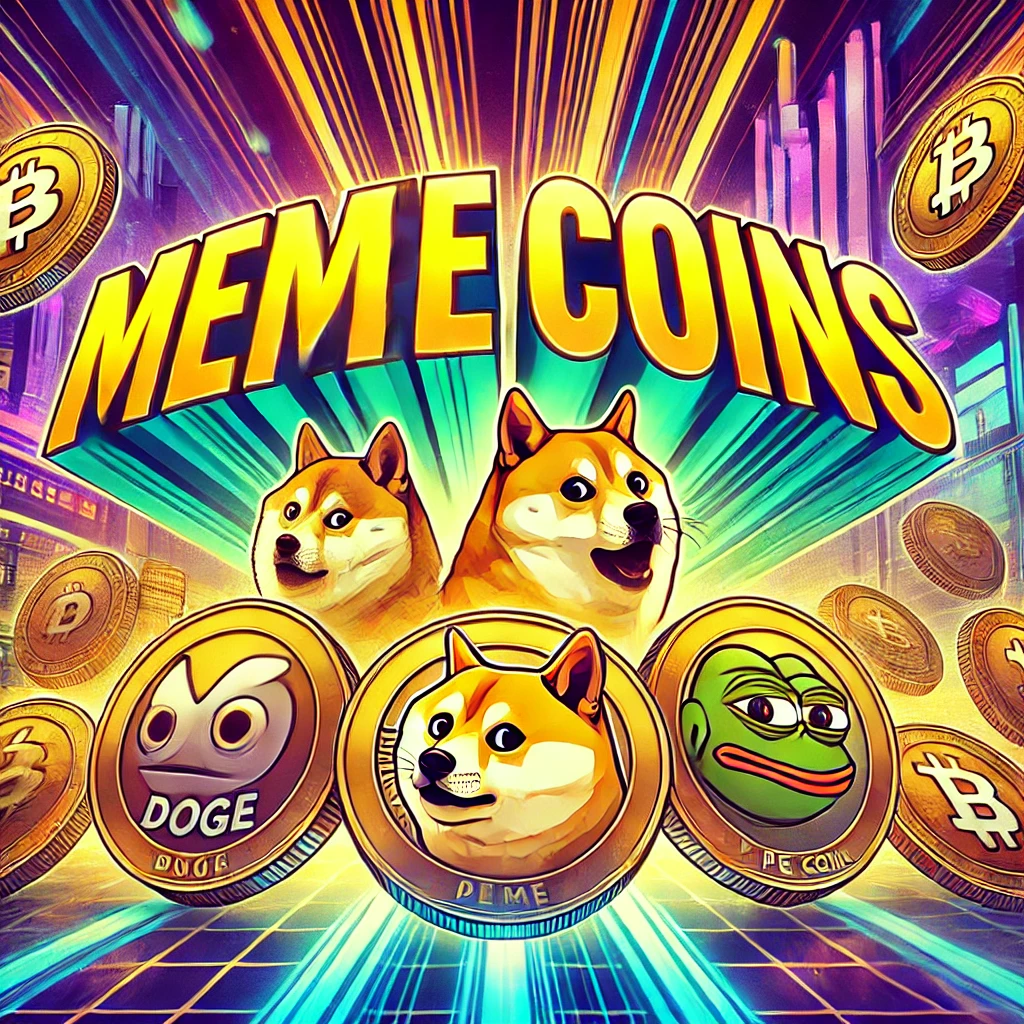
DALL·E 2025-01-29 13.37.37 - A vibrant and engaging digital illustration of meme coins in the cryptocurrency space. The image should prominently feature the heading _Meme Coins_ i

Are Meme Coins a Good Investment?

Are Meme Coins a Good Investment? Risks, Hype & Market Trends

As cryptocurrency markets continue to evolve, meme coins have captured widespread attention, drawing in speculative investors with their humor-driven branding and explosive price movements. These digital tokens—often built around internet culture, satire, or even absurdity—have proven that hype alone can fuel their ascent. But as history shows, what rises quickly can just as easily come crashing down.

With meme coins like Dogecoin (DOGE) and Shiba Inu (SHIB) demonstrating unexpected staying power, while others fizzle out just as fast as they emerge, the question remains: Are meme coins a fun bet or a financial trap?

What Defines a Meme Coin?

Meme coins are cryptocurrencies that exist primarily as internet-driven phenomena. Unlike Bitcoin or Ethereum, which are backed by technical innovation and decentralized finance (DeFi) applications, meme coins have no inherent use case or technological advantage. Their value is largely dictated by online hype, social media buzz, and community engagement.

Some key characteristics that define meme coins include:

  • Satirical or humorous origins – Most meme coins are created as jokes or cultural references rather than serious financial projects.
  • Community-driven growth – The success of meme coins depends largely on their online following, with viral social media activity fueling their adoption.
  • Extreme volatility – Unlike traditional assets, meme coins are highly susceptible to pump-and-dump cycles and unpredictable price swings.
  • Limited intrinsic value – Without a concrete use case or development roadmap, meme coins lack the fundamentals that typically support long-term investments.

A Short and Wild History of Meme Coins

The first meme coin, Dogecoin (DOGE), emerged in 2013 as a lighthearted response to the rapid rise of cryptocurrencies. What started as a joke quickly gained traction, with a loyal community using DOGE for tipping and charitable donations.

Fast forward to 2020, Shiba Inu (SHIB) was launched as a self-proclaimed “Dogecoin killer,” leveraging social media campaigns and celebrity endorsements to skyrocket in value. By 2021, the meme coin mania had reached new heights, with countless imitations like Akita Inu, Kishu Inu, and SafeMoon flooding the market.

However, the same speculative fervor that fueled their rise also led to their downfall. As the cryptocurrency market corrected in late 2021, many meme coins lost over 90% of their value, exposing the fragile nature of hype-driven investing.

In 2023, the emergence of PEPE—a meme coin based on the internet’s Pepe the Frog character—once again reinvigorated interest in the sector. Despite its initial success, concerns over its association with fringe internet groups raised ethical questions about meme coin culture.

The Risks of Meme Coin Investing

For every success story, there are countless failed meme coins that leave investors with nothing but losses. Some of the biggest risks associated with meme coins include:

  • Scams and rug pulls – Fraudulent projects can lure in investors with fake hype, only for the creators to disappear with their funds.
  • Regulatory uncertainty – Meme coins exist in a legal gray area, and future regulations could significantly impact their market presence.
  • Lack of long-term viability – While some meme coins like DOGE and SHIB have sustained relevance, most experience a short-lived price surge before fading into obscurity.
  • Speculative trading environment – Meme coin markets are often driven by retail traders looking for quick profits, leading to high volatility and unpredictable price action.

Meme Coins in 2025: Hype vs. Reality

As of 2025, meme coins remain a polarizing force in the crypto space. While their appeal lies in their community-driven ethos and potential for massive gains, the reality is that they function more like speculative bets than legitimate investments.

Some of the most talked-about meme coins today include:

  • Dogecoin (DOGE) – The original meme coin continues to hold value, largely due to its first-mover advantage and celebrity endorsements.
  • Shiba Inu (SHIB) – With its own decentralized exchange (ShibaSwap) and Layer-2 blockchain (Shibarium), SHIB has attempted to expand beyond its meme coin origins.
  • Dogwifhat (WIF) – A new entry into the meme coin world, using humor and social media to drive adoption.
  • Election-themed meme coins (BODEN, TREMP) – Satirical tokens based on political figures that gained traction during the 2024 U.S. elections.
  • OFFICIAL TRUMP & MELANIA MEME – High-profile meme coins launched by the incoming U.S. president and first lady, raising ethical concerns about political involvement in crypto markets.

The Bottom Line

Meme coins are, by nature, unpredictable. While they offer entertainment value and the potential for quick profits, they also come with extreme risks. The lack of intrinsic value, reliance on social media trends, and history of price collapses make them a highly speculative investment.

For those willing to embrace the gamble, meme coins can be a thrilling—if dangerous—ride. But for serious investors looking to build sustainable wealth, traditional cryptocurrencies and blockchain projects with solid fundamentals remain the smarter choice.

Get Started with your Stock Investments today with MINTALPHAA.

Get deeper insights into the crypto market’s weekly trends discussed on our Spotify podcast.

Screenshot 2025-01-26 at 1.06.02 PM

Solana Blockchain Scalability – MintingM

Solana Blockchain Scalability: Speed, Efficiency, and Innovation

Solana has quickly become one of the most talked-about blockchain platforms in the world of decentralized finance (DeFi) and cryptocurrencies. Known for its high transaction speeds and low fees, Solana has positioned itself as a direct competitor to Ethereum, with unique technological advancements and a rapidly growing ecosystem. This article delves into Solana’s origins, its key features, and how it compares to other blockchains.

What is Solana?

Solana is an open-source blockchain platform designed to host decentralized, scalable applications (dApps). Established in 2017, it is governed by the Solana Foundation in Geneva, while the core blockchain infrastructure was developed by Solana Labs in San Francisco. Solana gained massive popularity in 2021 when its native cryptocurrency, SOL, surged by over 12,000%, briefly achieving a market capitalization of $75 billion. Despite market volatility, Solana remains one of the top cryptocurrencies by market cap in 2024.

At its core, Solana is built to solve blockchain scalability challenges, enabling faster transactions and significantly lower fees compared to platforms like Ethereum.

The Technology Behind Solana

Solana leverages a combination of proof-of-stake (PoS) and a novel consensus mechanism called proof-of-history (PoH) to achieve unparalleled speed and efficiency.

Proof-of-History (PoH):

  • Introduced by Solana’s co-founder, Anatoly Yakovenko, PoH timestamps transactions to verify the order and timing of events on the blockchain.
  • Traditional blockchains rely on validators’ local clocks, which can cause delays and inefficiencies. PoH standardizes time across the network, enabling Solana to process transactions at lightning speed.

Transaction Speed and Scalability:

  • Solana’s architecture can theoretically handle up to 710,000 transactions per second (TPS) on a standard gigabit network and 28.4 million TPS on a 40-gigabit network.
  • On Sept. 18, 2024, Solana processed over 2,400 TPS, with an average transaction cost of just $0.00026, a stark contrast to Ethereum’s 15 TPS and $0.30 average transaction fee.

Validator Clusters:

  • Unlike traditional validator nodes, Solana employs validator clusters—groups of validators working in tandem to process transactions. This innovation reduces bottlenecks and improves network efficiency.

The Rise of Proof-of-History

Yakovenko’s white paper on PoH, published in 2017, marked a turning point in blockchain technology. PoH addressed a critical challenge faced by early blockchains: the lack of a trusted, standardized clock. By encoding time directly into the blockchain, PoH enables Solana to achieve remarkable speed and scalability, outpacing older systems like Bitcoin and Ethereum.

While Ethereum’s upgrade in 2022 improved its scalability through the merging of its Beacon Chain and Mainnet Chain, Solana’s unique PoH mechanism remains a competitive advantage, allowing it to process transactions faster and at a fraction of the cost.

Solana vs. Ethereum

The rivalry between Solana and Ethereum has dominated blockchain discourse, given their shared focus on dApps, DeFi, and NFTs.

  • Smart Contracts: Both platforms support smart contracts, which are essential for enabling decentralized applications.
  • Transaction Speed and Cost: Solana outshines Ethereum with faster transaction speeds and lower fees. While Solana’s transaction cost averages $0.00026, Ethereum’s fees remain higher, even post-upgrade.
  • Consensus Mechanism: Both use PoS, but Solana’s integration of PoH provides an edge in speed and efficiency.
  • Ecosystem: Ethereum’s first-mover advantage and extensive ecosystem make it the dominant blockchain for dApps, though Solana’s ecosystem is expanding rapidly.

Ethereum’s planned upgrade introducing danksharding may close the performance gap, but Solana’s innovation in scalability keeps it a formidable competitor.

Use Cases and Ecosystem

Solana’s versatility has made it a hub for a wide range of applications, including:

  • DeFi: Solana supports decentralized finance protocols that leverage its high-speed, low-cost infrastructure.
  • NFTs: Solana has emerged as a leading platform for NFTs, with projects utilizing its efficiency for minting and trading digital assets.
  • Tokenization: Solana employs its SPL Token standard, akin to Ethereum’s ERC-20, for creating and managing digital assets.

Does Solana Have a Future?

Solana’s innovative technology and expanding ecosystem suggest a promising future, though challenges remain. The blockchain’s ability to sustain its competitive edge against Ethereum’s upgrades and the emergence of new platforms will determine its long-term success.

Investors and traders should consider Solana’s solid community support, technological advancements, and its position in the rapidly evolving cryptocurrency market. However, as with any investment, risks remain, particularly in such a volatile industry.

Solana’s combination of scalability, speed, and affordability makes it one of the most compelling blockchain platforms today. By addressing the shortcomings of traditional blockchains and incorporating groundbreaking technologies like proof-of-history, Solana has carved out a niche as a high-performance alternative to Ethereum. While competition in the blockchain space continues to intensify, Solana’s innovative design and strong community support position it as a key player in the future of decentralized technology.

Get Started with your Stock Investments today with MINTALPHAA.

Get deeper insights into the crypto market’s weekly trends discussed on our Spotify podcast.

what-is-DeFi

Decentralized Finance (DeFi) – MintingM

Decentralized Finance (DeFi): The Revolution Reshaping Financial Systems

Decentralized Finance, better known as DeFi, is redefining the way the world interacts with money. Built on the principles of blockchain and peer-to-peer networks, DeFi challenges traditional banking systems, promising greater accessibility, transparency, and efficiency. By eliminating intermediaries such as banks, DeFi empowers individuals to transact directly, opening the door to a financial system unbound by borders or centralized control. However, as revolutionary as it is, this space comes with complexities, opportunities, and risks worth exploring.

The Core of DeFi: How It Works

At its heart, DeFi leverages blockchain technology to facilitate secure, peer-to-peer transactions. Traditional financial institutions rely on intermediaries to process payments, offer loans, or provide trading platforms. In contrast, DeFi eliminates these middlemen by using smart contracts—self-executing agreements embedded in code that automatically execute once specific conditions are met.

For instance, in a DeFi loan, the lender and borrower agree on terms directly through a smart contract. The blockchain securely records and executes the transaction, providing transparency while reducing overhead costs and time delays.

Applications within DeFi include cryptocurrency wallets, decentralized exchanges, lending platforms, and more. These apps allow users to send money, borrow, trade, or invest with nothing more than an internet connection and a compatible wallet, highlighting DeFi’s borderless nature.

Advantages of DeFi: Breaking Down the Benefits

One of DeFi’s most appealing features is its accessibility. Traditional financial systems often exclude individuals without access to banking infrastructure. DeFi, however, only requires an internet connection, allowing anyone globally to participate in lending, borrowing, trading, or saving.

Additionally, DeFi offers low fees and flexible terms. Unlike traditional banks that charge significant fees and impose strict terms, DeFi platforms let participants negotiate directly. Interest rates, repayment periods, and loan terms can all be customized, ensuring a tailored experience.

Security and transparency are other cornerstones of DeFi. Transactions are recorded on a blockchain, making them immutable and publicly verifiable. While participants remain pseudonymous, their transactions are traceable, ensuring accountability.

Applications and Use Cases Driving DeFi Adoption

DeFi’s versatility is evident in the variety of financial services it offers. Decentralized exchanges (DEXs) like Uniswap and PancakeSwap enable users to trade cryptocurrencies without intermediaries, reducing fees and increasing security.

Liquidity pools and yield farming have also gained popularity. Liquidity providers lock funds in pools to facilitate trades on exchanges, earning fees or interest in return. Yield farming, a derivative of this concept, allows users to maximize returns by strategically moving assets between pools offering the best rewards.

Additionally, DeFi has expanded into areas like prediction markets, non-fungible tokens (NFTs), and even decentralized insurance, showcasing its broad utility. For example, platforms like Aave offer decentralized lending and borrowing, enabling users to earn interest or access funds without traditional credit checks.

Challenges in the DeFi Ecosystem

Despite its promise, DeFi is not without challenges. Security remains a pressing concern. The immaturity of the technology, coupled with poorly audited code, has made some platforms vulnerable to hacks and exploits, resulting in significant financial losses for users.

Regulation—or the lack thereof—also looms over DeFi. Traditional financial laws are built for centralized systems with clear jurisdictional boundaries. DeFi, with its global, decentralized nature, defies these frameworks, raising questions about enforcement and accountability.

Moreover, price volatility in the cryptocurrency market adds another layer of complexity. While DeFi offers innovative financial solutions, its reliance on cryptocurrencies means users must navigate substantial market risks.

Is DeFi Worth the Hype?

The promise of DeFi is undeniable, but it is not without its caveats. For individuals with a high risk tolerance and the ability to navigate the complexities of blockchain technology, DeFi offers unparalleled opportunities. From earning passive income through yield farming to accessing global financial markets, the potential rewards are substantial.

However, for the average investor or someone seeking stable, long-term financial growth, DeFi’s volatility and infancy make it a challenging landscape. With less than 1% of global financial assets currently tied to cryptocurrencies, DeFi remains a niche sector. Its long-term success will depend on resolving technological vulnerabilities, establishing clear regulatory frameworks, and building user trust.

Looking Ahead: The Future of DeFi

As DeFi continues to evolve, it stands at the intersection of innovation and risk. The ongoing development of blockchain technology, coupled with growing interest from institutional investors, suggests that DeFi will play a significant role in shaping the financial systems of tomorrow.

Yet, the journey is far from over. DeFi platforms must address security concerns, enhance user experiences, and work with regulators to ensure a balanced ecosystem. As traditional banks and financial institutions explore blockchain solutions, the lines between centralized and decentralized finance may blur, leading to hybrid models that combine the strengths of both systems.

Get Started with your Stock Investments today with MINTALPHAA.Get deeper insights into the crypto market’s weekly trends discussed on our Spotify podcast.

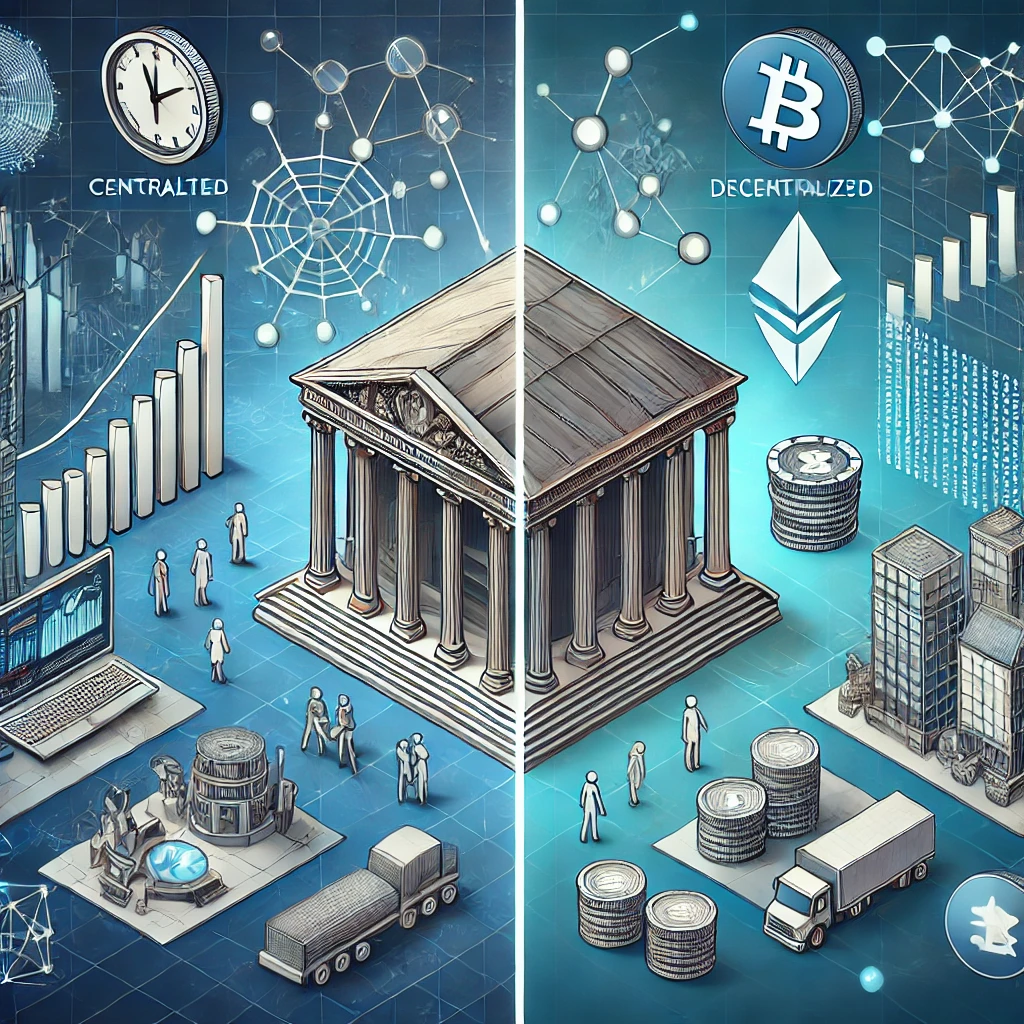
DALL·E 2025-01-22 18.32.22 - An engaging and professional illustration comparing centralized and decentralized markets. On the left side, a structured environment representing cen

Centralized vs Decentralized Markets

Centralized vs. Decentralized Markets: A Comparative Analysis

The financial world is divided into two distinct market structures: centralized and decentralized. Both serve as vital mechanisms for facilitating trade, but they differ significantly in structure, function, and underlying philosophy. Understanding these differences is crucial for investors, traders, and businesses navigating modern financial ecosystems.

What Is a Centralized Market?

A centralized market is a structured environment where all trading orders are routed through a single exchange. This model ensures a unified price for securities and offers transparency and regulation to investors.

Key Features

  • Unified Price Mechanism: Centralized markets quote a single price for assets, eliminating discrepancies and making price movements more predictable.
  • Transparency: All trade data, including quotes and executed trades, is visible, enabling informed decision-making.
  • Clearinghouses: Transactions are routed through clearinghouses, reducing counterparty risk by ensuring both buyers and sellers deal with the exchange rather than each other.

Examples

Prominent centralized markets include:

  • Stock Exchanges: The New York Stock Exchange (NYSE) and Tokyo Stock Exchange (TSE) operate on centralized models where trades are matched via a central platform.
  • Commodity Markets: Exchanges like the Chicago Mercantile Exchange (CME) use a centralized approach for trading commodities.

Advantages

  • Fair pricing through a single marketplace.
  • Reduced counterparty risk due to clearinghouse involvement.
  • High transparency and regulatory oversight, ensuring investor protection.

Limitations

  • Limited flexibility for participants as all trades must occur through the central exchange.
  • Potential inefficiencies due to reliance on a single point of control.
  • Susceptible to system-wide disruptions in case of technical failures.

What Is a Decentralized Market?

In contrast, a decentralized market eliminates the need for a central exchange by enabling buyers and sellers to trade directly using technology. These markets rely on peer-to-peer networks and are particularly prevalent in the digital age.

Key Features

  • Peer-to-Peer Trading: Decentralized markets connect buyers and sellers directly without intermediaries.
  • Flexibility: Participants can access multiple trading platforms and explore varying price points.
  • Virtual Market Integration: Blockchain technology powers many decentralized markets, facilitating cryptocurrency transactions.

Examples

  • Foreign Exchange (Forex): Currency trading occurs globally without a central hub, enabling traders to find competing rates from different dealers.
  • Real Estate: Buyers and sellers often complete transactions directly, bypassing centralized clearinghouses.
  • Blockchain and Cryptocurrencies: Platforms like Bitcoin and Ethereum operate as decentralized financial ecosystems.

Advantages

  • Freedom from regulatory constraints, allowing for greater flexibility.
  • Reduced transaction costs due to the absence of intermediaries.
  • Resilience against single-point failures.

Limitations

  • Lack of oversight increases risks of fraud and market manipulation.
  • Difficulty enforcing legal frameworks.
  • Price discrepancies due to fragmented markets.

Emerging Trends: The Rise of Decentralized Markets

The advent of blockchain technology and digital currencies has accelerated the growth of decentralized markets. By enabling direct peer-to-peer transactions and offering greater anonymity, decentralized markets are becoming a preferred choice for many modern traders.

Decentralized Currency

Cryptocurrencies like Bitcoin and Ether operate without the need for central banks, providing users with autonomy over their finances. This innovation has fueled the growth of decentralized virtual markets, though debates over regulation persist.

Hybrid Models

Some platforms are exploring hybrid models that incorporate the transparency of centralized markets with the flexibility of decentralized ones. This approach aims to combine the best of both worlds, addressing concerns like regulatory compliance and transaction efficiency.

The Bottom Line

Centralized and decentralized markets cater to different needs and philosophies. Centralized markets excel in providing stability, transparency, and regulatory protection, making them ideal for traditional asset classes. On the other hand, decentralized markets champion flexibility, autonomy, and technological innovation, particularly in digital and emerging asset spaces.

Understanding the strengths and limitations of each market structure allows investors to align their strategies with their objectives. Whether you prefer the structured environment of centralized markets or the dynamic possibilities of decentralized platforms, the choice ultimately depends on your trading goals and risk appetite.

Get Started with your Stock Investments today with MINTALPHAA.

Get deeper insights into the crypto market’s weekly trends discussed on our Spotify podcast.

Screenshot 2025-01-20 at 7.05.53 PM

Heikin-Ashi Chart Analysis – MintingM

Heikin-Ashi Chart Analysis: The Smarter Approach to Analyzing Market Trends

Heikin-Ashi, translating to “average bar” in Japanese, has emerged as a game-changing technique for traders seeking clarity in volatile markets. By smoothing out candlestick patterns, this method makes it easier to spot trends and identify trading opportunities. Whether you’re navigating stocks, cryptocurrencies, or commodities, Heikin-Ashi charts can offer a more refined perspective compared to traditional candlesticks.

The Mechanics of Heikin-Ashi Charts

At its core, Heikin-Ashi modifies the way candlestick charts are calculated, using a unique formula that emphasizes average price movements. Unlike traditional open-high-low-close (OHLC) candles, Heikin-Ashi employs close-open-high-low (COHL) calculations:

  • Close = (Open + High + Low + Close) / 4 (average price of the current bar)
  • Open = (Open of the previous bar + Close of the previous bar) / 2 (midpoint of the previous bar)
  • High = Maximum of High, Open, or Close
  • Low = Minimum of Low, Open, or Close

These calculations give Heikin-Ashi charts their distinctive smooth appearance. Instead of alternating colors frequently as seen in standard candlesticks, Heikin-Ashi candles maintain consistent colors during uptrends and downtrends, reducing market noise and making trends easier to interpret.

Interpreting Heikin-Ashi Signals

Heikin-Ashi charts provide five primary signals to guide traders in identifying trends and making informed decisions:

  1. Hollow or green candles with no lower shadows indicate a strong uptrend, signaling traders to stay long and let profits accumulate.
  2. Hollow or green candles with lower shadows suggest an uptrend, inviting traders to add to long positions or exit shorts.
  3. Candles with small bodies and both upper and lower shadows indicate a potential trend change. Risk-tolerant traders may act here, while others might wait for confirmation.
  4. Filled or red candles signify a downtrend, prompting traders to add to short positions or exit longs.
  5. Filled or red candles without upper shadows highlight a strong downtrend, advising traders to remain short until a reversal appears.

These signals are particularly useful because they reduce the number of false indicators that often disrupt traditional candlestick analysis, allowing traders to identify trends more reliably.

Advantages of Heikin-Ashi Charts

Heikin-Ashi charts excel in simplifying trend analysis, making them suitable for traders across various markets. Their ability to smooth out volatility and highlight trends ensures that traders can stay in positions longer during strong trends and exit strategically during periods of uncertainty.

For instance, during a market decline, Heikin-Ashi charts show long red candles with minimal lower wicks, signaling a strong downtrend. As buying pressure builds, the lower wicks elongate, and the candles eventually shift to green, marking the start of an upward trend. This clear visual distinction makes it easier for traders to decide when to enter or exit a trade.

Limitations and Complementary Tools

Despite its benefits, Heikin-Ashi has limitations. Because it averages price data, the values on a Heikin-Ashi chart may not match real-time market prices. This discrepancy means traders must pair Heikin-Ashi with other technical analysis tools to fine-tune their entry and exit points. Indicators like moving averages, Bollinger Bands, and the Relative Strength Index (RSI) complement Heikin-Ashi, offering additional insights into price behavior.

Another limitation is the potential lag in trend identification. While the smoothing effect helps clarify trends, it may delay the recognition of reversals. Traders should remain cautious and use Heikin-Ashi as part of a broader strategy rather than relying on it in isolation.

Practical Applications and Reliability

Heikin-Ashi charts can be applied to any market, from equities to cryptocurrencies. Most charting platforms now include Heikin-Ashi as an option, reflecting its growing popularity among traders. By reducing market noise, Heikin-Ashi helps traders focus on the bigger picture, making it easier to identify consistent trends and stay in profitable trades longer.

While Heikin-Ashi does not display real-time prices, its ability to highlight trading opportunities with reduced false signals makes it an invaluable tool for technical traders. Its reliability, however, depends on its integration with other analysis methods and the trader’s familiarity with the tool.

However, as with any trading tool, Heikin-Ashi should be used alongside other technical indicators to ensure accurate decision-making. By leveraging this innovative technique, traders can stay ahead of the curve, making smarter and more informed moves in today’s dynamic financial landscape.

Get Started with your Stock Investments today with MINTALPHAA.

Get deeper insights into the crypto market’s weekly trends discussed on our Spotify podcast.